There are two primary ways to think about groups, either as a generalization of “combination”-style operations (e.g. addition or multiplication, which combine two numbers to form another number), or in terms of symmetries. I will briefly describe both of these approaches below.
Combinations
A group must have a combination operation that satisfies the following properties:
- Closure: for two elements , is also in .
- Associativity: for , .
- Identity element: there exists such that .
- Inverse element: for all , there exists an element such that .
Some basic examples of groups:
- The set of integers equipped with the operation (addition). The identity element is , and the inverse of is .
- The set of integers under mod () equipped with .
- equipped with , where is a prime (but NOT arbitrary or , since an inverse element does not always exist).
- The set of -dimensional real vectors equipped with vector addition.
- The set of invertible real matrices equipped with matrix multiplication, also known as the general linear group or .
Symmetries
One may also think of a group in the context of an object , then define a group as the set of transformations that leave unchanged.
For instance, let be an equilateral triangle. Then, the following transformations will leave unchanged:
- Rotation by 0, 120, or 240 degrees.
- Reflection across any of the triangle’s three altitudes.
Before we move on, we should clarify what exactly it means for two transformations to be different. Why should we consider 0 and 360 the same but 0 and 240 different, when both leave the triangle unchanged? In other words, how can we “see” the difference?
One easy fix is to number the triangle’s vertices 1, 2, 3 in clockwise order. Then, one may verify that each of the six operations listed above are distinct. One may then note that these are the only six distinct transformations, as there can only be at most ways to rearrange the vertices.
Considering the same problem but on a square, these are the eight possible transformations constituting the group :
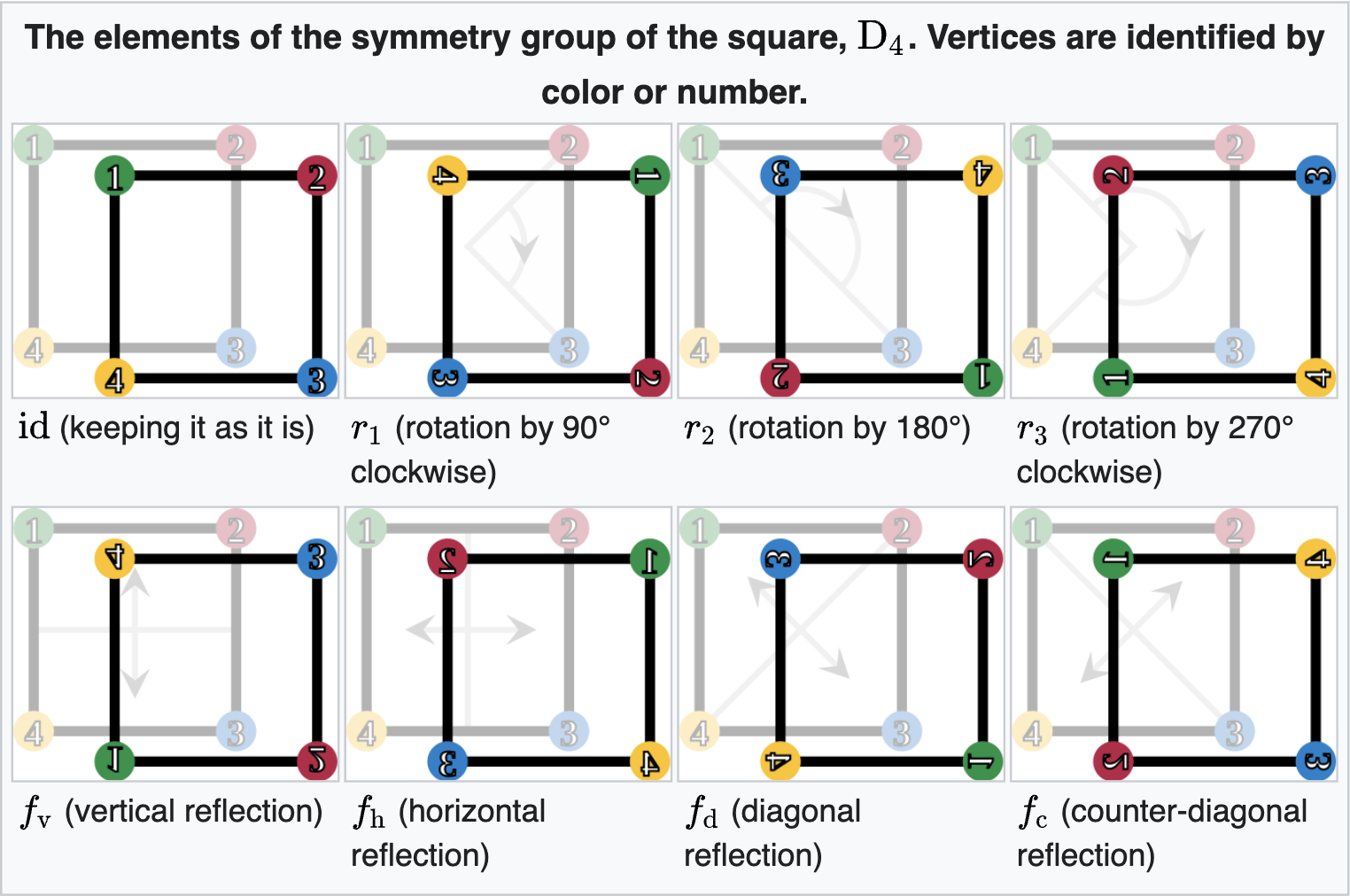
Image from Wikipedia.
Note that this is less than the total ways of rearranging vertices arbitrarily.