Definitions
We denote a massed point with mass as , or just if the mass is clear. We denote the center of mass of two massed points and as , and define it as
In other words, we take the weighted average of the two points and add their masses.
Exercise
What is ?
(To reiterate, denotes a point at with mass , and denotes a point at with mass .)
Solution
The center of mass of those two points is .
Exercise
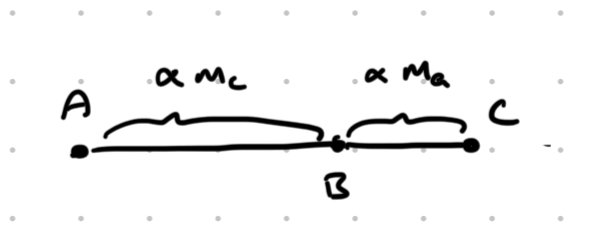
Show that lies on the line segment , and moreover that .
Both have rather boring algebraic proofs, but the intuition typically given is to consider a seesaw balanced at and recall the physical fact that should be balanced on both sides: that is, .
It should be clear that is commutative, but perhaps a little less obvious that it’s associative:
Exercise
Show that .
Hint
It may help to rewrite points in weighted-point form, where is instead written as . How can we find when all points are written in this form?
(For instance, we would rewrite as .)
Solution
Using this form, we can show that . Note that this is just vector (component-wise) addition, which we already know is associative.
A triangle
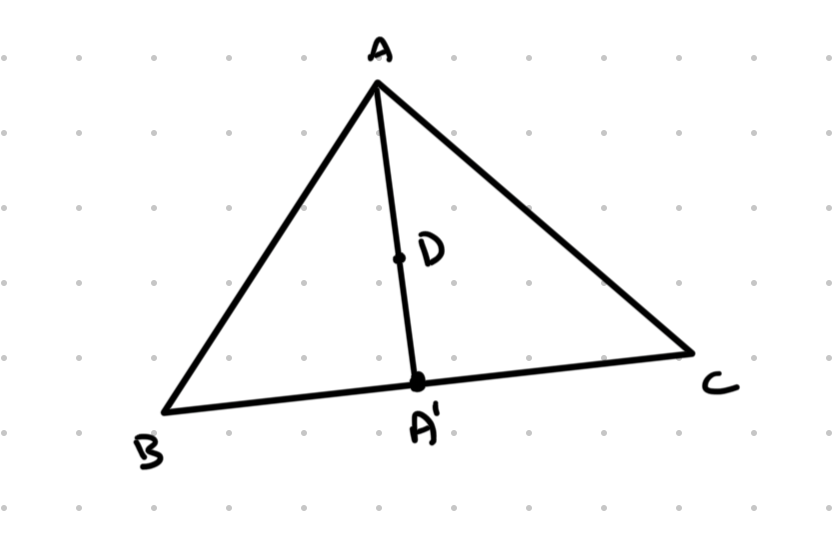
The typical use case of this is as follows: draw a triangle and the point .
Exercise
If , show that .
Solution
Just expand by associativity!
Similar flavor but a bit harder:
Exercise
If and is the intersection of line and segment , prove that .
Solution
Since , the second exercise guarantees that lies on . Moreover, since , must lie on line as well. Therefore, is precisely the intersection between segment and line .
Typically, we are not given the masses of and but rather several side lengths from which the masses are to be deduced:
Exercise
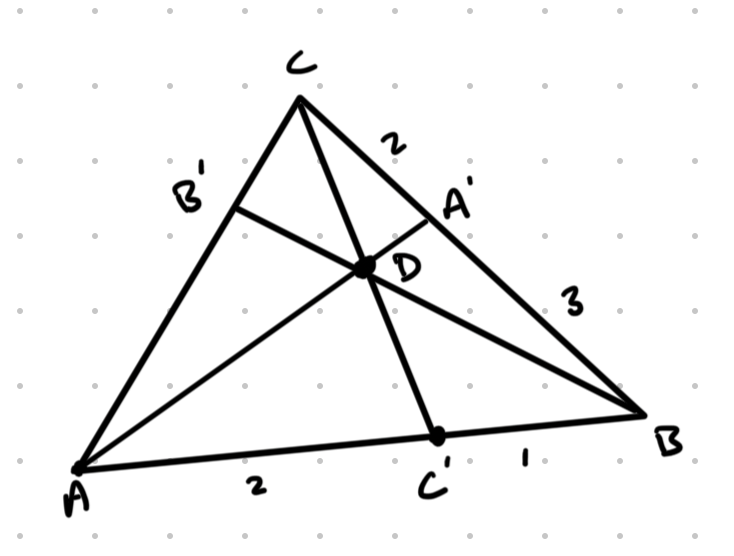
Assign masses to points and such that , then use these masses to calculate .
Hint
Use the “seesaw” property we learned from the second exercise, as well as what we learned about and from the previous exercise!
Solution
Assume . Then, by the previous exercise, we know that , and .
Because and the seesaw property, we know that , so let’s just assign .
Similarly, because and the seesaw property, we have that . Therefore, all three weights have been uniquely determined (up to a constant multiplication). We can now use the seesaw property with to determine that .