Overview
A metric space is a collection of points that additionally has a way to define the distance between every pair of points, which must satisfy the following conditions:
Some examples of metric spaces include:
- with Euclidean distance
- with Manhattan distance
- a weighted graph with shortest-path distance
A fun visual for the last example, courtesy of this math exchange answer:
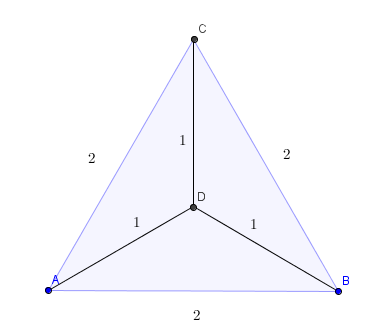
notes from napkin
Convergence
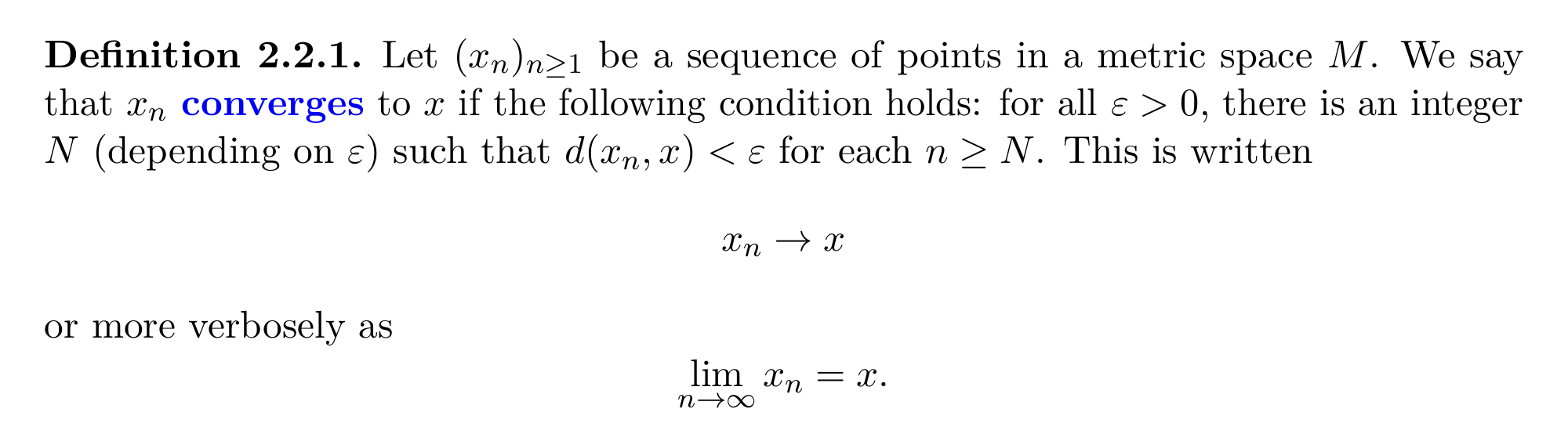
2.2.4: The convergent sequences in a discrete metric space (where different points have distance 1 and all others have distance 0) are precisely those which eventually become constant.
Continuity
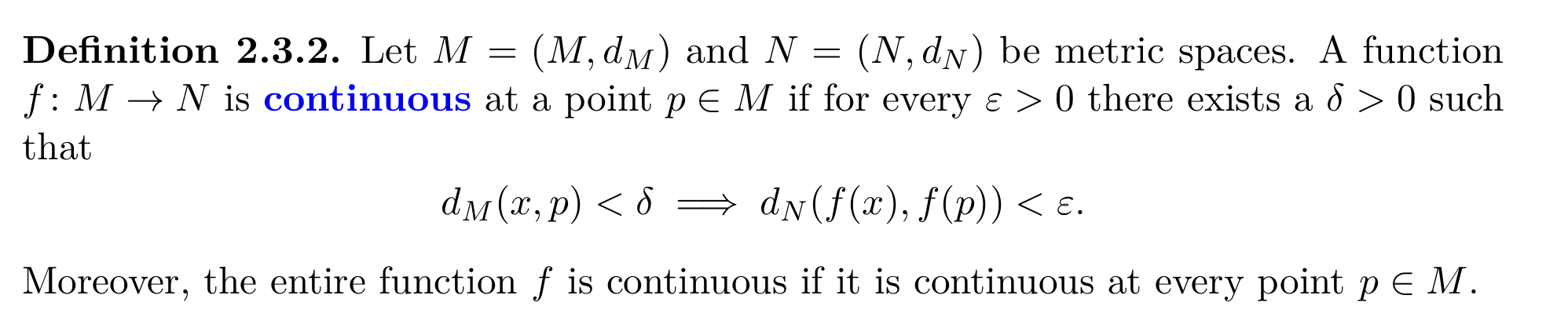
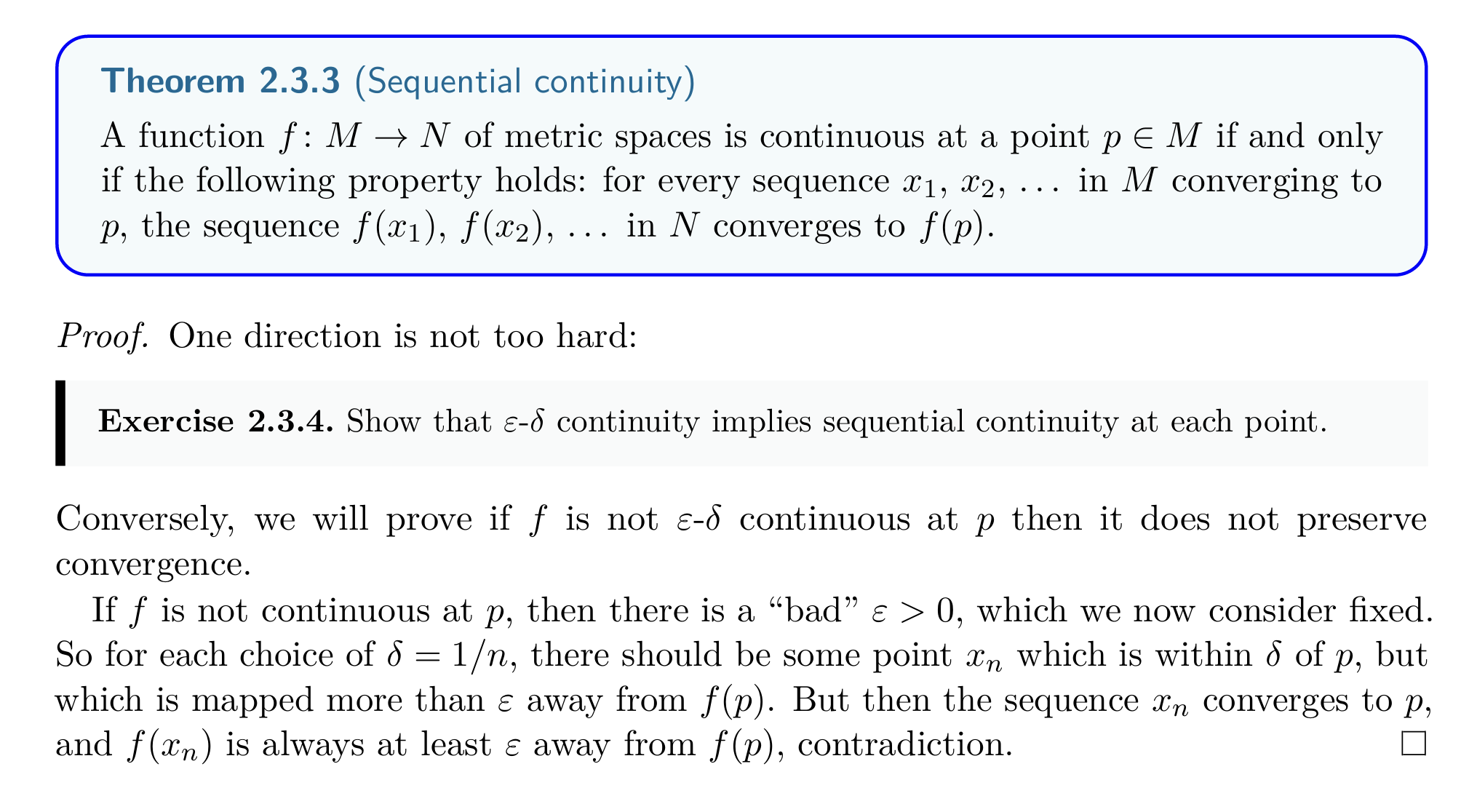
2.3.4: Given continuity and a sequence converging to , our goal is to find, for all , some such that . By continuity, there must be some such that ; therefore, it suffices to find some such that . Such an must exist by the convergence of .
To reiterate the converse proof shown above, if continuity does not hold, we can explicitly construct a sequence such that converges to , but does not converge to .

is always continuous. As noted before, any convergent sequence in must become some constant after some . Therefore, always converges to . Intuitively, this is because no two points in are “next” to each other, and therefore they are all independent.
Homeomorphisms

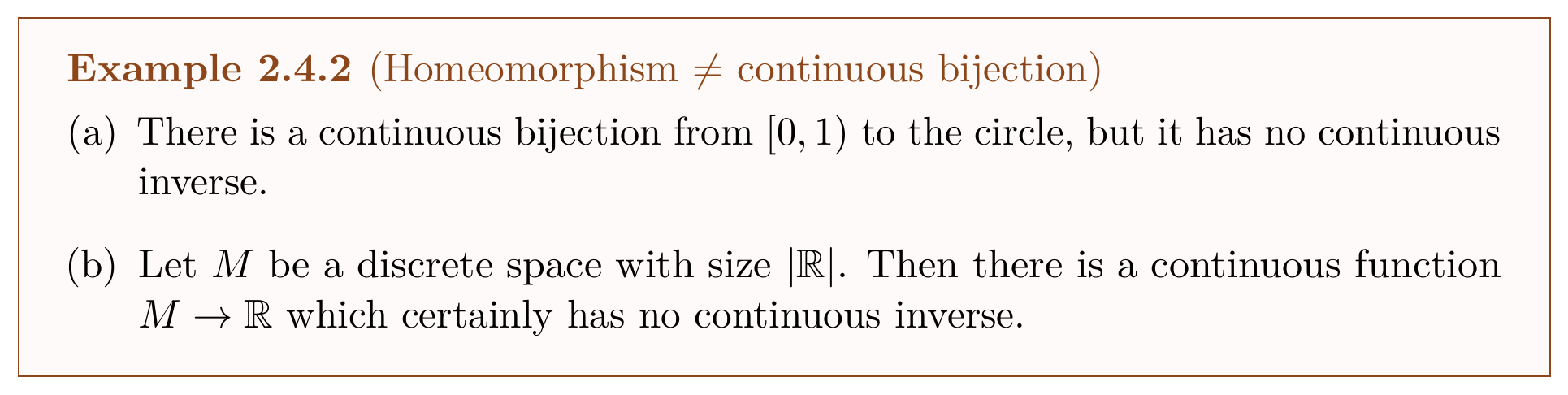
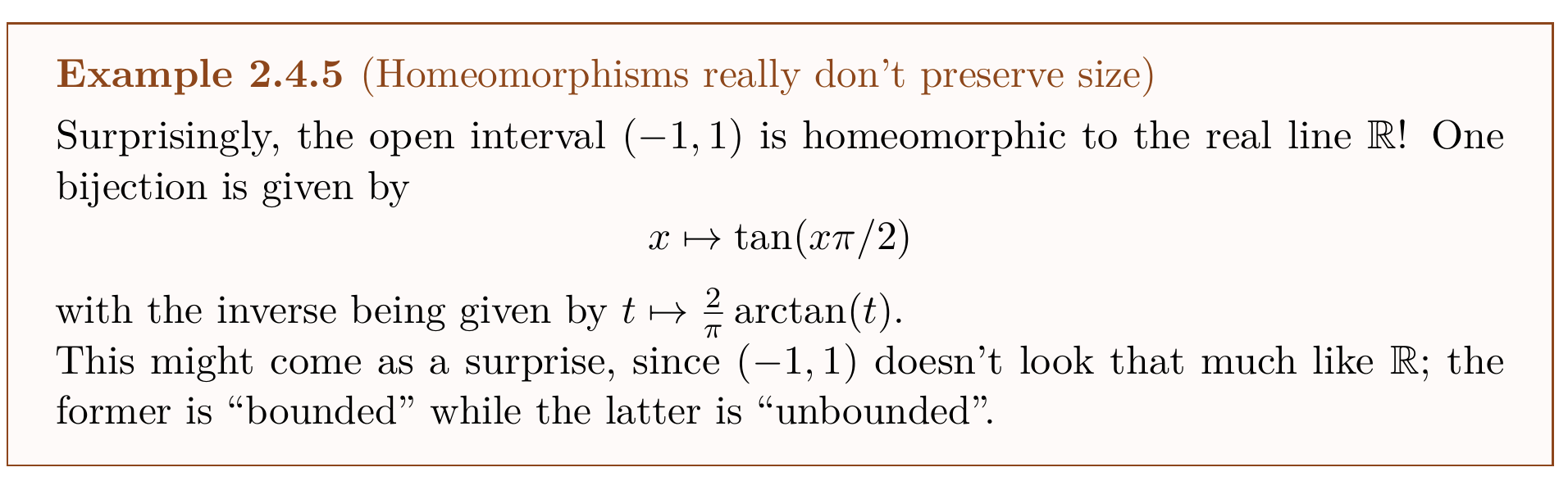
Why must we require the inverse also to be continuous?
Open sets


is open in (but not in ), while is open in neither.
Question 2.6.7. What are the open sets of the discrete space?
All subsets are open, since we can always select .
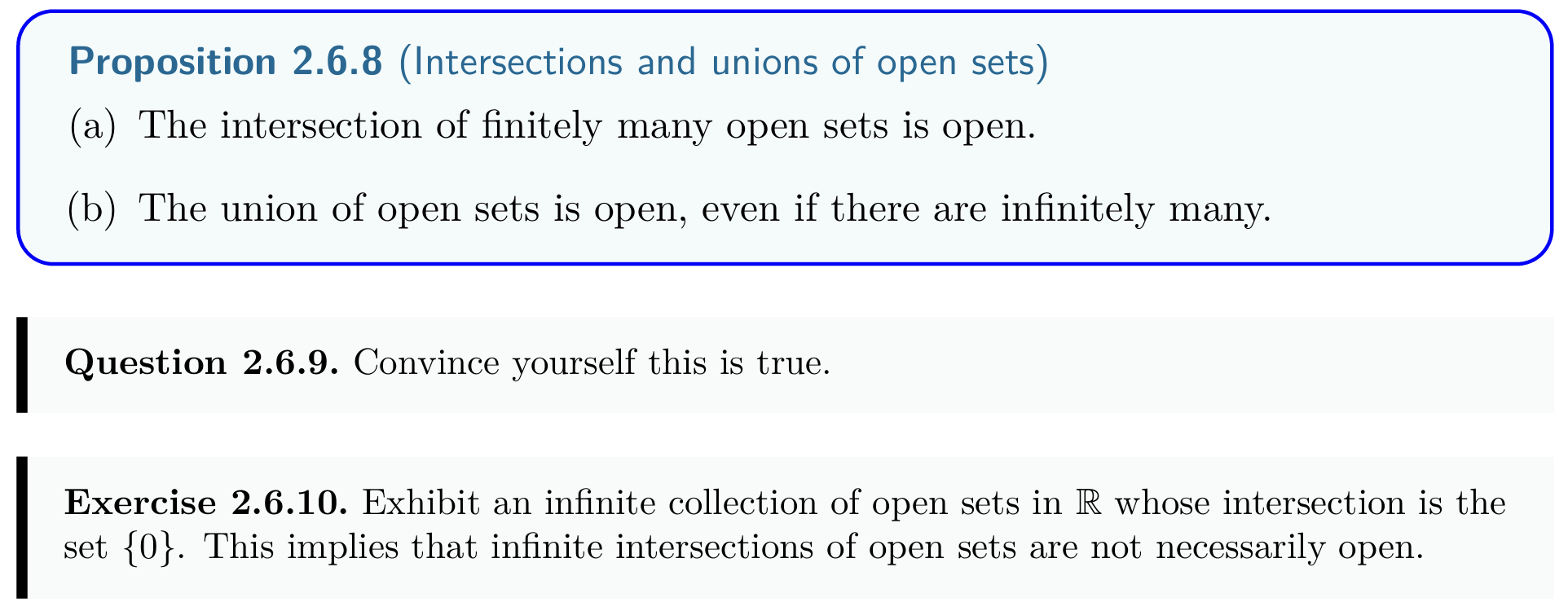
For a), just set for each point equal to the minimum viable among all the intersected sets. The same choice of suffices for .
An infinite collection of open sets in whose intersection is are the sets .

Closed sets
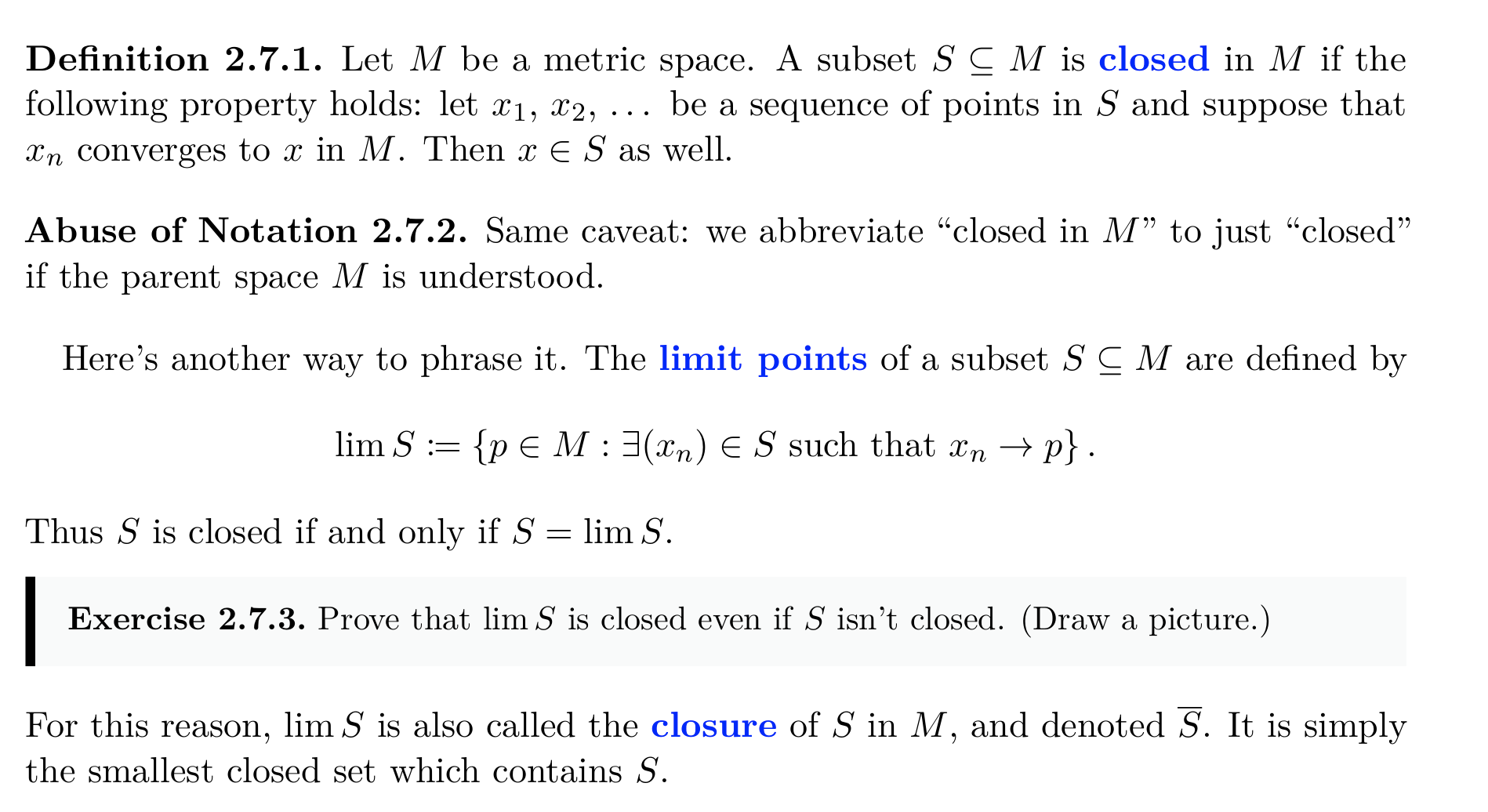
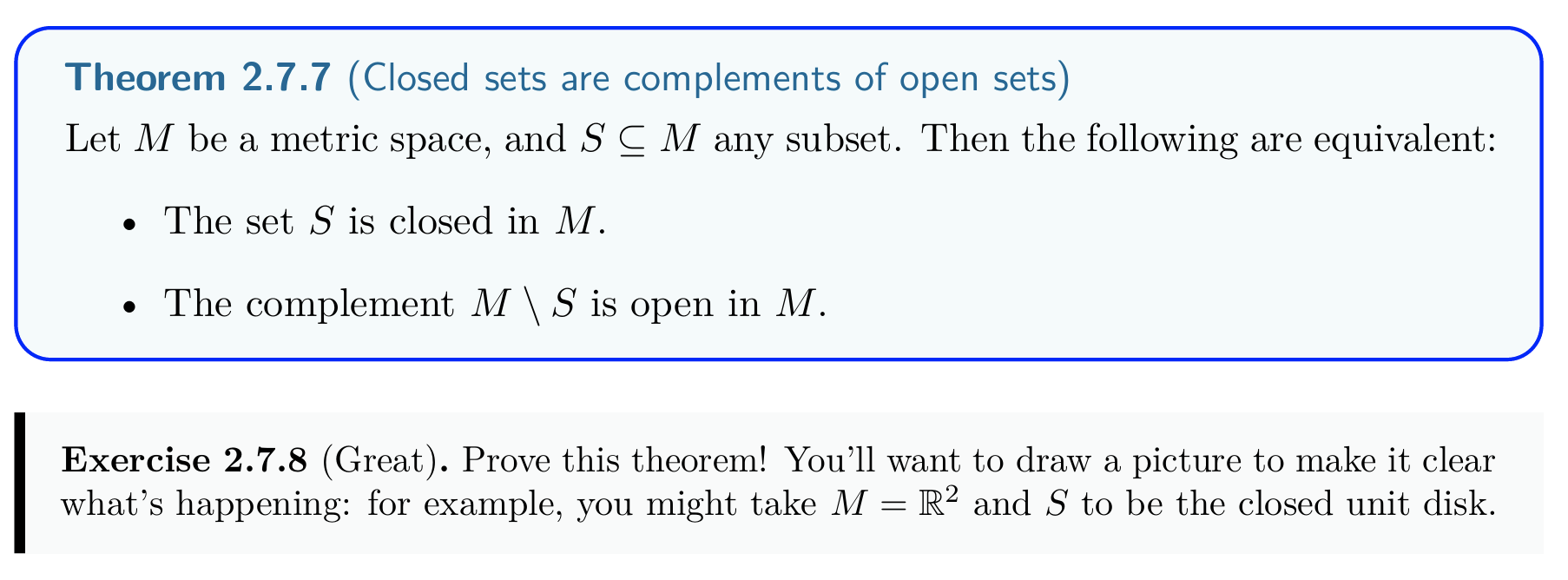
First, we show that if is closed, must be open. Assume for contradiction that there exists some such that for every , there exists some such that . Then, we can write a sequence containing these values of for , which thus converges to . This means , a contradiction.
A similar contradiction argument works in the reverse direction. Suppose is open, and there exists a sequence of elements that converges to an element in . Then has no -neighborhood in for any , contradicting the openness of .
Completeness
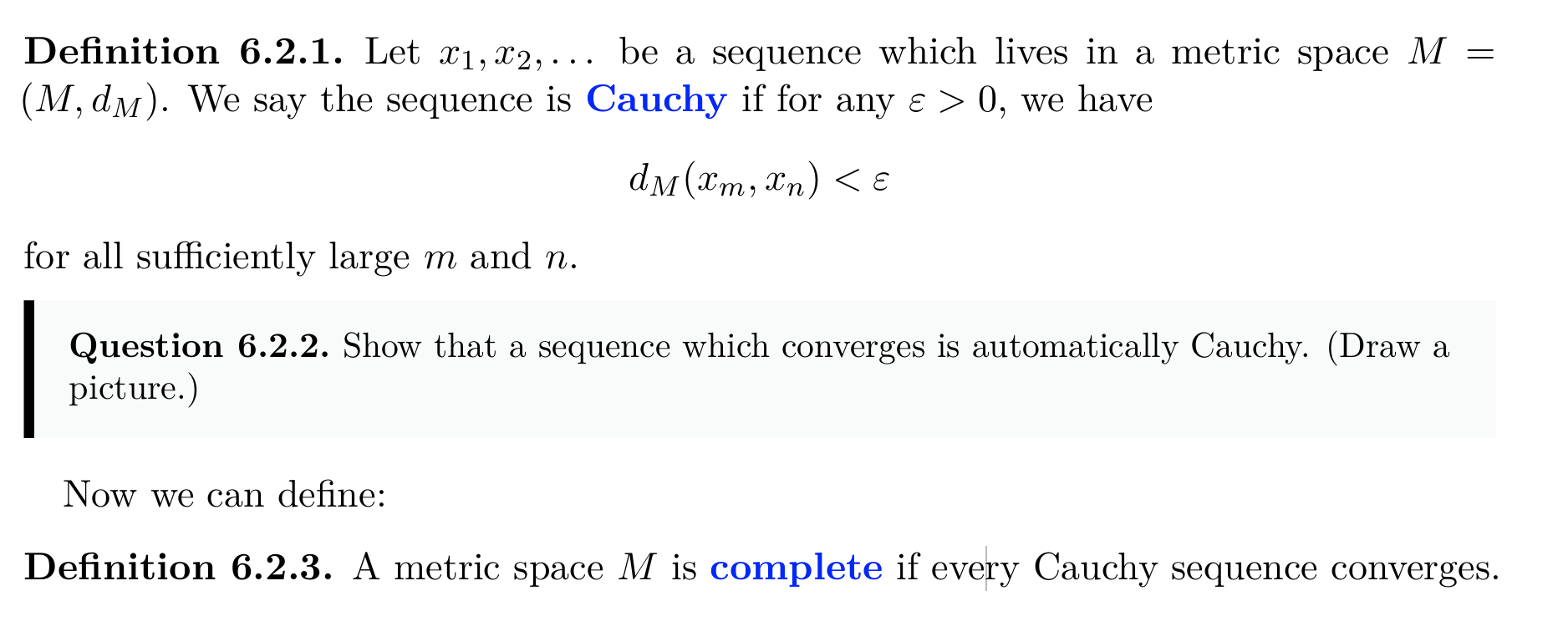
If the sequence converges, can we select such that for all . By the triangle inequality, this means , as desired.
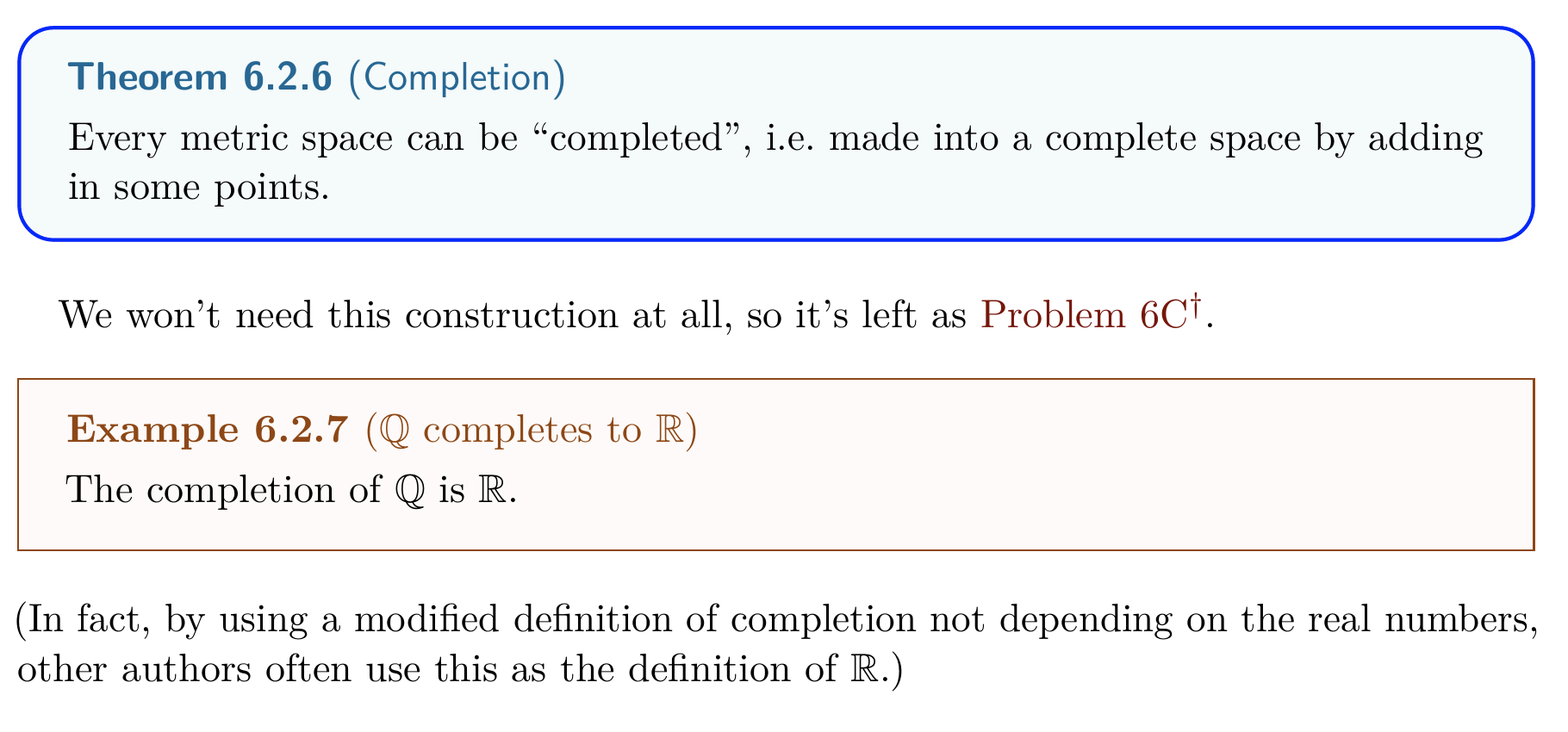

We first prove that if is complete, it is closed in . This is because any convergent sequence in is a Cauchy sequence, which by completeness must converge to another element in .
Moreover, because is a complete metric space, any Cauchy sequence in must converge to some element in . Therefore, if is closed in , all such convergent points must be contained in , making it closed.

Sketch. Take any starting point ; we will show that iterating on will eventually converge to a fixed point. This is because the sequence is Cauchy, and is a complete metric space.