First, observe that for two slimes and with distinct and , exactly one of them can eat the other (if , neither can eat the other). In particular, can eat if . Also note that we can consider each component in independently, since no slimes can eat through . In particular, for each component, we care about whether can eventually eat it or not.
To build some intuition, here are some visuals for cases with :
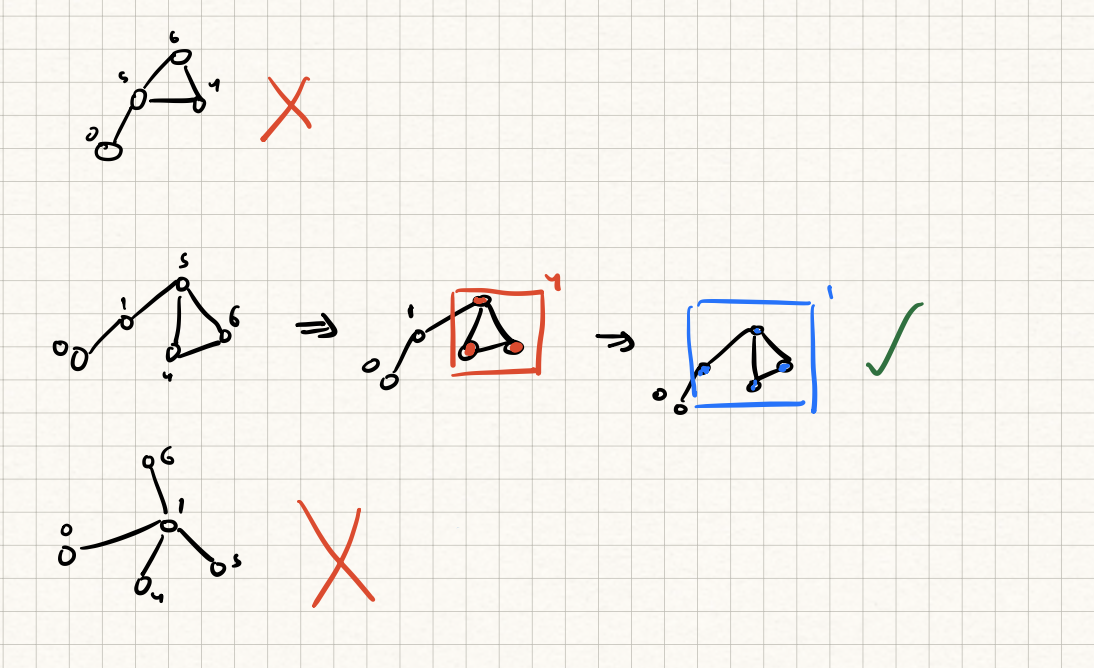
*WLOG, we will assume .
The first case is impossible because cannot eat any of , , or .
However, this is remedied with the presence of the in the second case, which can be eaten by but can also eat , which in turn can eat and . A possible sequence of events is shown above.
Still, in the third case, we see that the presence of an intermediate such as does not necessarily guarantee success. Indeed, this case is impossible because and can only be eaten if is eaten through first. Therefore, the remaining value will be , making it yet again impossible for to continue eating. However, if the middle value were , or if all the outer values were changed to , this would again be possible.
To formalize this a little bit, let be the node in the component with the largest satisfying : this is the largest possible “intermediate”, which we will try to use to eat larger values.
For a concrete example, if , we can actually always win by the following procedure:
- While there exists with , find one such adjacent to with . Since there exists , such a pair is guaranteed to exist. Then, have one of eat the other. Importantly, note that itself can never be eaten by this procedure.
- Now, there exists only , which can all be eaten by node which has .
So in this example, there are only two categories of slimes: , which we’ll refer to as P-type, and , which we’ll refer to as Q-type (in order to be consistent with the official editorial). However, if , we must introduce an additional R-type, which satisfies .