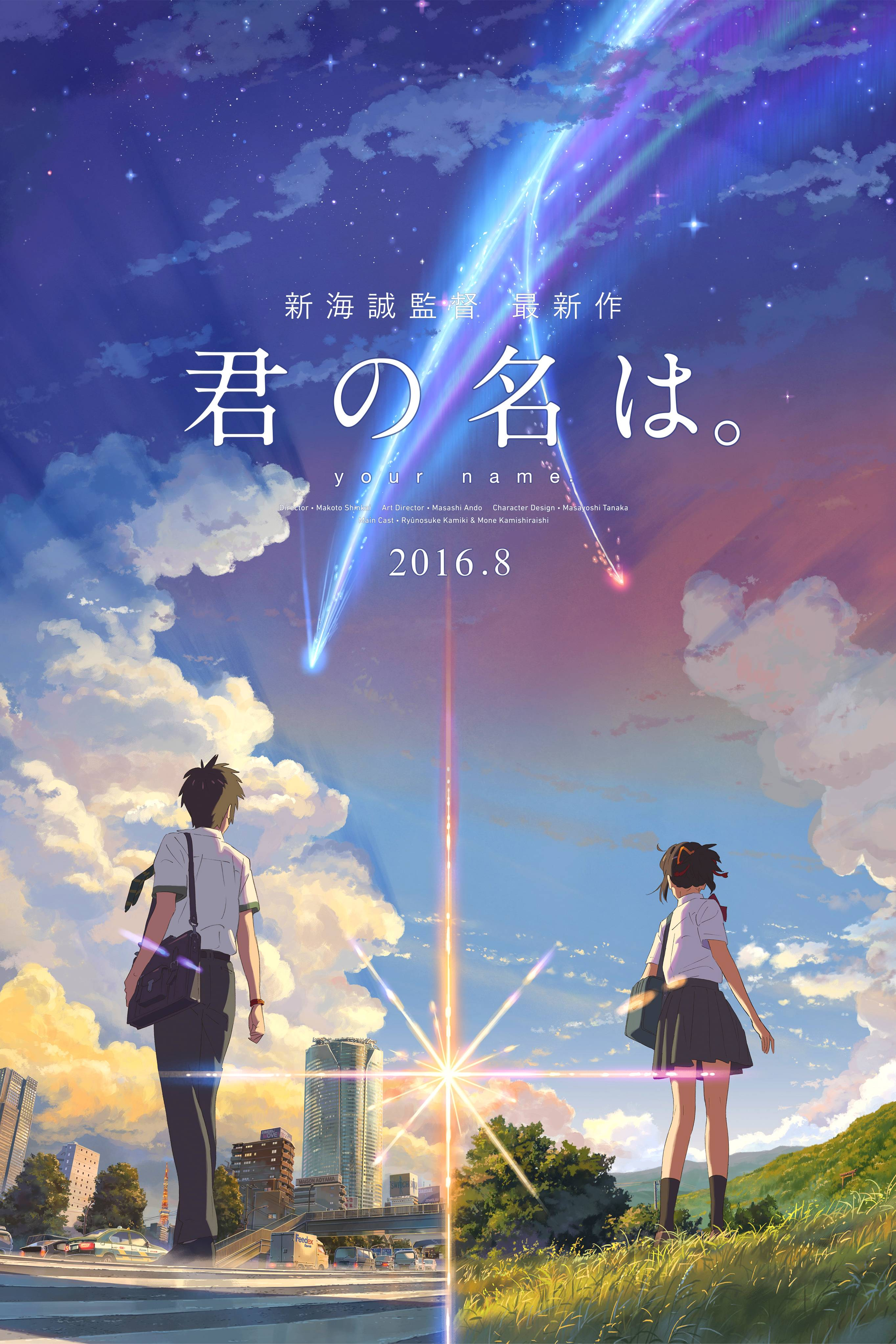
Rating: more objectively a 9/10, but I’m biased so 10/10
First Impressions
A beautiful anime movie. Some plot points were kind of unclear, but the emotional impact hit hard. When they meet at kataware-doki…
I really like how the classic idea of “red thread of fate” is blended with the sci-fi “time-loop” concept---the connection between Taki and Mitsuha starts only because Mitsuha gives him the red cord, but she also only gives him that cord because they are already connected. Therefore, the connection between the two is “fated” by the offset of their timelines.
Also the kuchikamizake trip.scene might be some of the coolest animation I’ve ever seen :)
The Plot
Here are some questions I had after watching and the answers I came up with. Some of the following information comes from the Earthbound light novel, which helps clarify some important plot points that couldn’t be squeezed into the movie’s runtime.
Why does the body-swapping happen in the first place?
Grandma notes that the weaving process has a magical aspect, through which one can infuse their own soul and voice into the cords. Thus, Mitsuha’s red cord contains part of her, and when worn by Taki, forges a bond between the two that transcends space and time.
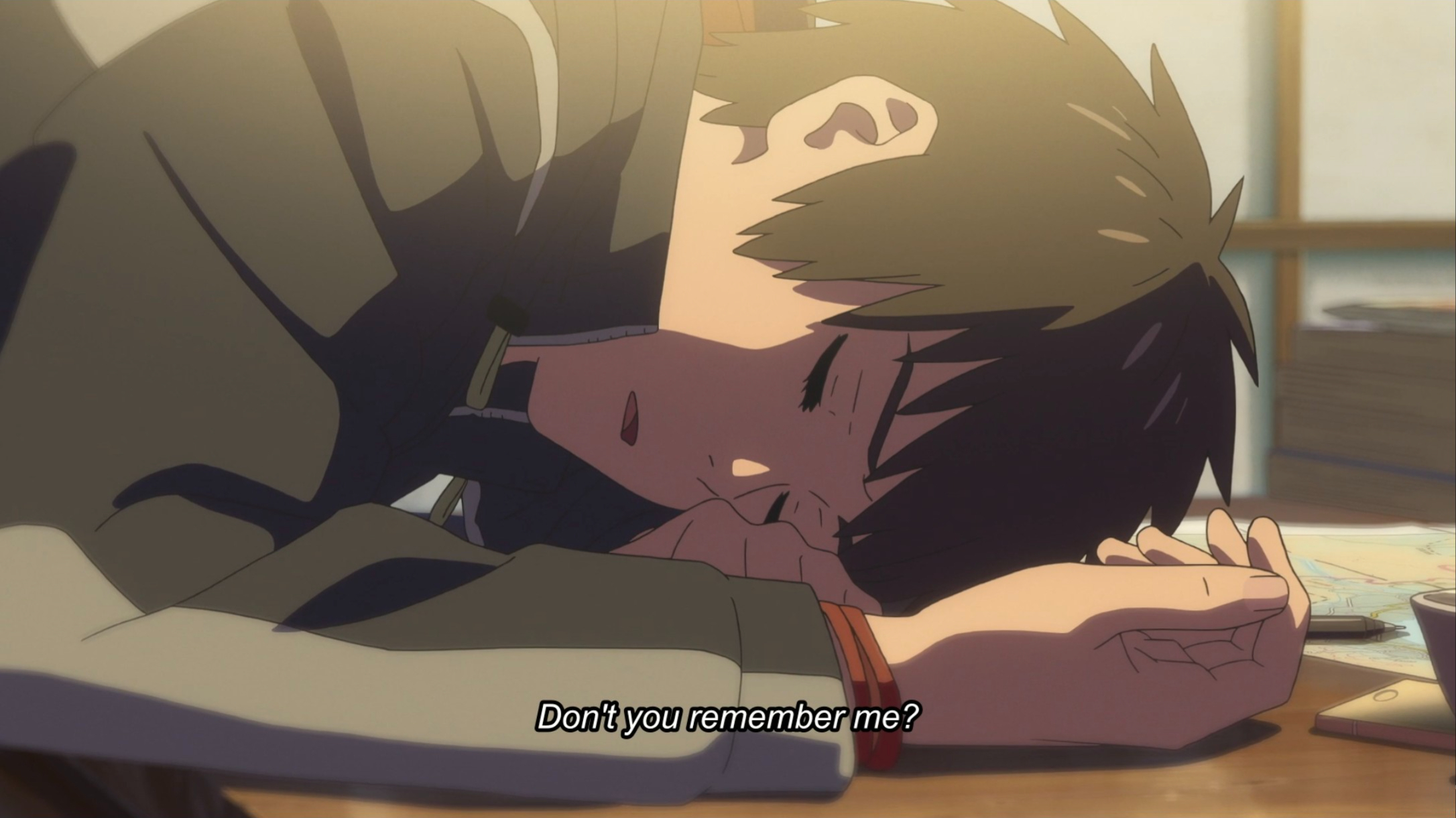
Mitsuha speaks (or rather, Taki remembers) through the cord.
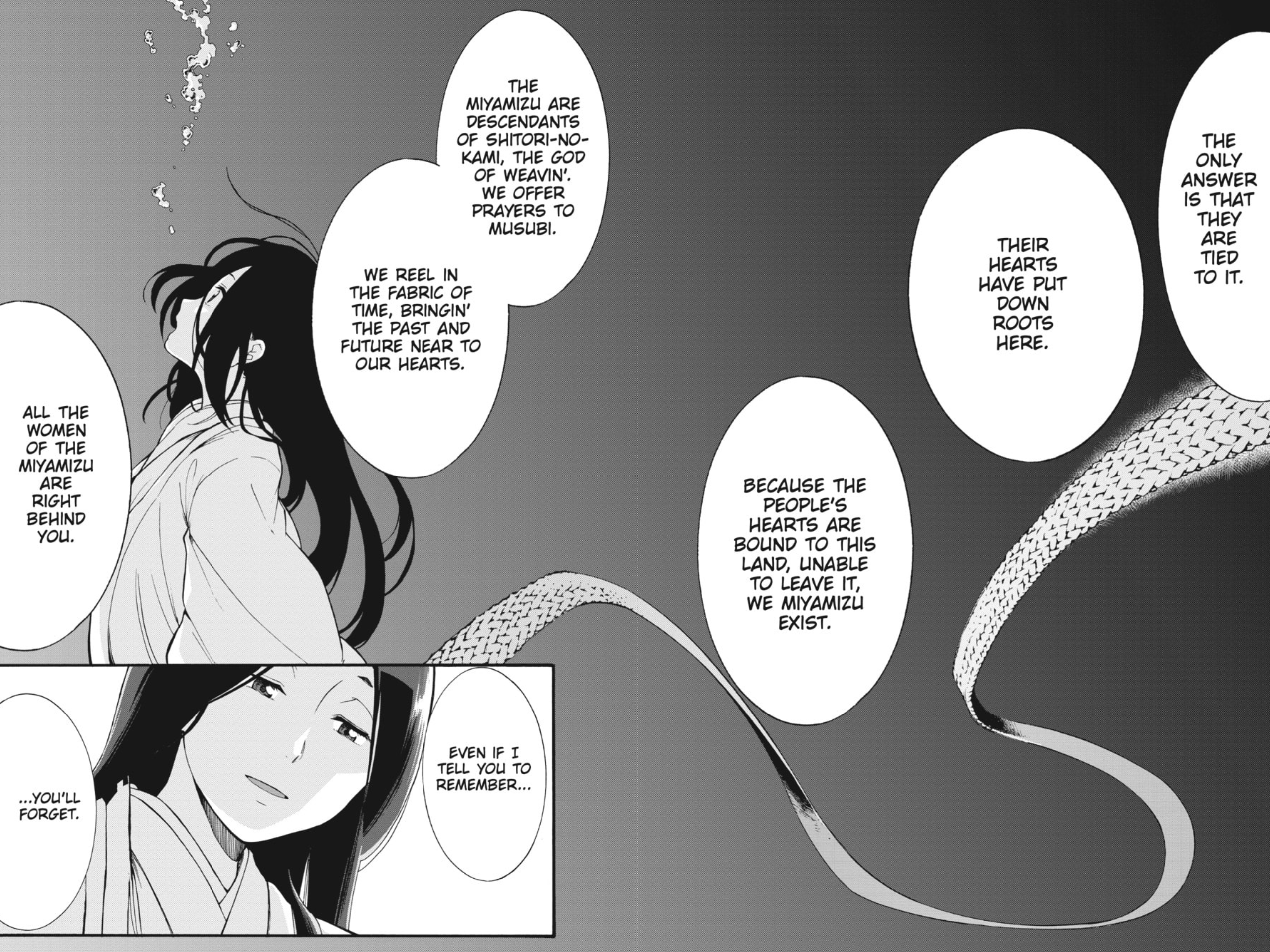
More generally, according to Earthbound, “the Miyamizu are descendants of shitori-no-kami, the god of weaving…we reel in the fabric of time, bringing the past and future near to our hearts.” We see Yotsuha experience a swap in Earthbound as well, where she switches into the body of one of her ancestors. This demonstrates that although the Miyamizu share this body-switching experience, the guy-girl swap is specific to Mitsuha.
Thus, the whole point of the weaving tradition is to grant the weavers a degree of clairvoyance. The reason why is also explained in Earthbound: the comet-god (who’s also a dragon, which you can see during the kuchikamizake trip) is the enemy of the weaving god, who protects Itomori through the cords. This leads into another big question…
Why didn’t their ancestors just leave Itomori when the first comet fragment hit?
One of the main ideas of Earthbound---communicated directly by the title---is the inexplicably deep connection between a people and their homeland, no matter how dangerous it may be to continue living there. This idea is especially relevant in Japan, where disasters strike much more frequently than they do elsewhere.
“In exchange for returning to this world, you must leave behind what is most important to you—the kuchikamizake. You’ll offer it inside the god’s body. It’s half of you.”
When Hitoha says this to Mitsuha, it’s actually Taki in her body. So, “half of you” could actually be referring to Taki leaving behind his other half, Mitsuha, as after this moment, the two never body-switch again.
Why didn’t Taki write his name on Mitsuha’s hand?
In the moment, I think he simply expected he’d have more time. Also, he intended to go look for Mitsuha, so all that would’ve mattered to him is remembering her name, not necessarily Mitsuha remembering his.
However, it also wouldn’t have helped much if Taki had actually written his name. We see later that even when Taki hears Tessie’s name, he feels a vague sense of familiarity but still doesn’t remember anything about him. Even when Taki recognizes Mitsuha’s red cord and runs out into the subway station, he doesn’t search any further because he still thinks his feelings are irrational. In the end, the only reason the two get to meet again is because of the look they shared of mutual recognition, confirming that their respective feelings weren’t just one-sided delusions.
How much do Taki/Mitsuha actually remember?
I think, in the “fixed” timeline, both remember the events exactly as one would remember a dream. For Taki, we see that even before visiting Itomori, he seemed unable to recall many details: names, faces (educated guess since he didn’t draw any faces), etc. The only thing he remembers is the landscape, of which he produces many drawings. Importantly, these drawings are also the only physical evidence of his dreams and thus likely became the only part he remembered as time passed. When talking with Okudera, Taki describes this inexplicable attraction to the landscape of Itomori, but doesn’t remember anything past that, neither the events that transpired nor the people he met there. Of course, since it’s a dream, these memories are not completely lost but merely waiting to be reawakened.
For Mitsuha, she probably remembers dreaming about the comet splitting and saving the village because of it, but all the other memories are latent, just like Taki’s.
“The braided cords we make…represent the flow of time itself. They twist, tangle, sometimes unravel, break, then connect again.”
This quote actually encapsulates the structure of the entire movie. We have the twisting and tangling of Mitsuha and Taki, the unravelling and breaking of their bond, and their ultimate reconnection.
Through their weaving tradition, the Miyamizu are able to temporarily manipulate the threads of time and connect to the past or future. And, like dreams, even when these temporary deviations are reconnected to the main thread---memories erased, notes deleted---they still inevitably change its overall shape.
Themes/Ranting
Stories about dreams are always fascinating. One of my favorite phrases comes from Inception, when Saito describes Cobb as someone from a “half-remembered dream.” That sentiment has always stuck with me---how can a dream be so vivid, yet so easily, but never completely, forgotten? What Your Name explores is how this can apply just as much to real life: you may forget the details of events, or the faces and even names of people, but your emotions surrounding those events and those people will linger for much longer. For instance, I don’t remember many details from my trip in 8th grade to Washington, D.C, but there are certain images and emotions I associate with that week that I’ll never forget: the soft glow of scattered laughter beneath the moonlight, or that sensation of “in-between”, of being neither quite here nor there, on a night-time bus ride…
Your Name emphasizes that it is these retained emotions that change you most, not the specific events that caused them. This is why Taki writes “I love you” instead of his name on Mitsuha’s hand: his name would lose relevance to Mitsuha due to the paradox created by their meeting, but his love for her transcends that boundary. Even if she could deny Taki’s existence as a physical impossibility, she can’t deny the overwhelming love he left in her heart.
There’s also another more immediate message that can be taken from Your Name: don’t be scared to act! From the viewer’s perspective, we understand how deep the connection between Taki and Mitsuha goes; but by the end of the film, neither of the two do. Instead, they merely share this vague sentiment of familiarity without knowing why. Nonetheless, they both decide to act on it at the end, leading to a (hopefully) happy ending. So, the question left to the viewer is: what if you met the person at the other end of your red thread? What if you’ve met them already? Would you act, or just let them go?
Good Analyses
https://youtu.be/gqmXJSrMVUw?list=TLPQMjQxMTIwMjUQwuun4GSuvQ
- importance of lines---the cords, train lines, sliding doors
- in the metaphysical scene, the line transforms into the red thread, then the comet, then a single sperm cell
- cords (lines) vs tied cords (circles)
- each of Taki and Mitsuha only wear the cord when inhabiting their own bodies (that’s part of what completes them)
- Okudera’s wedding ring is also a circle
- period at the end of title is also a circle
https://www.reddit.com/r/KimiNoNaWa/comments/c18uv6/just_one_question_i_cant_find_anything_about_it/ (the bell ringing)
- sound is made by this ornament:
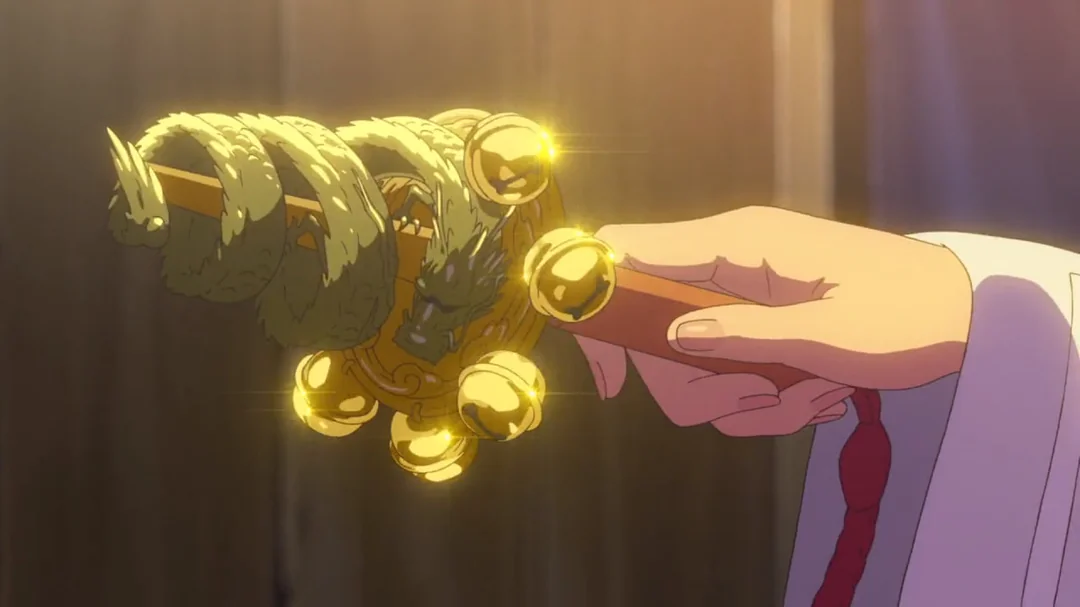
that gong sound - 43:53: Mitsuha sees comet for the first time
- if you feel a tug toward something, you’d better chase it