Rating: 6.5/10
The good
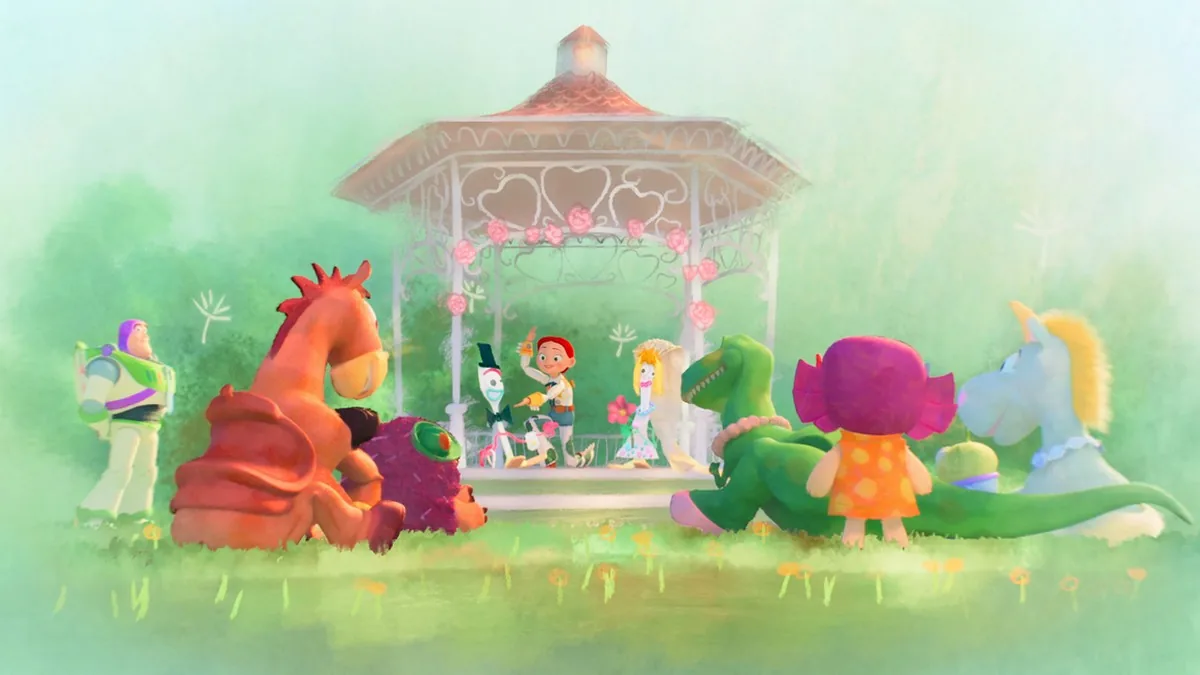
The best sequences were definitely the imagination-play ones, which had such a fun art style and pretty pastel colors (so maybe more aptly, “pastel playtime?”); perhaps I’m even more partial to them since they remind me of the art style of Gwen’s universe in Across the Spider-Verse.
I also think the moment when Jessie discovers her old owner, Emily, named her own daughter Jessie in remembrance was surprisingly poignant. Its message—that even though people inevitably drift apart, the moments we do share still matter—felt much more interesting and less in-your-face than the rest of the movie.
In isolation, I also do think Blaze was a pretty good character. When Jessie is thrown into the abandoned tea-house, it begs the question “does Blaze still play with toys or not?” as the moment comes right on the heels of her excitement at finding Bullseye. However, Blaze’s own “pastel playtime” sequence later answers this question in the affirmative and also reinforces the above theme by demonstrating the following: you can mature (i.e. stop playing with old toys) without losing your imagination.
The bad
Uncompelling plot
Unfortunately, the movie’s core message about devices—that they can actually help foster connection, but only in moderation—felt both overdramatic and boring at the same time. First, the inciting incident: you’re telling me that three girls who haven’t talked to Bonnie in a long time, but suddenly rediscover her existence via “The Pond,” immediately decide to invite her to a sleepover? Then, the same girls who understand enough to value the in-person connection brought by a sleepover…decide to start their weekend by sitting together on a porch, all staring at their tablets? Seems rather caricatured to me.
The movie also seems to present a false dichotomy between tech-lovers and nature-lovers. Aside from Bonnie, the two characters in the movie who still appreciate toys are Blaze, who loves animals, and the little camping boy who finds and keeps the Buzz toy. Unfortunately, this contrast feels a little too unsubtle for my taste.
None of this is to say I disagree with the movie’s message: in fact, I strongly agree with the sentiment that device usage needs to be replaced by both genuine person-to-person interaction, as well as time in nature. However, the way the movie conveys this message feels way too overt and made me feel more cringe than sympathy.
Plot holes
If the devices used Blaze’s/Bonnie’s account to send messages autonomously, wouldn’t their owners be both confused/scared of what was going on with their chats? However, neither character seems to show any concern over the fact that they’ve apparently sent never-written messages to one another; seems like a pretty big plot hole to me.